
JHDL 0.2
| JHDL Doc Home Page
| Examples Home Page
| << | <
| > | >>
Data Encryption Standard Example
This is an example of how jhdl can be used to create a circuit to
Encrypt and decrypt a file using DES.
DES has withstood more than 20 years of Cryptanalysis, and is still a
relatively secure algorithm. DES uses a 64-bit key to encrypt 64-bit
blocks of data through 16 rounds of permutations, xors, and table
look-ups. The key is also shifted and permuted at each stage to
increase security. DES is a symmetric algorithm, which means that
ciphertext created using a particular key can be decrypted into
plaintext using the same hardware and key circularly shifted to the
right instead of to the left. Below is a data flow graph of how DES works.
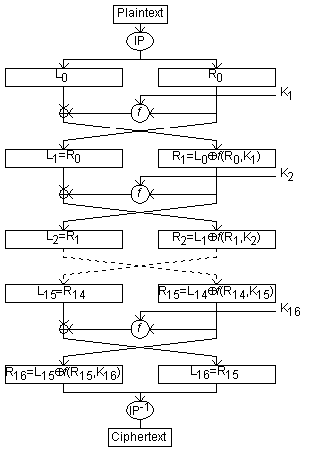
Each of the 16 rounds separates the data into 32-bit halves. The
right half is passed through to become the left half of the next
round and is expanded through a permutation to 48-bits before being
xored with the key. The xored value then becomes the addresses fo the
8 sboxes. These sboxes are basically small Look up tables. The
output of the sboxes is passed through another permutation before
being xored with the left half. This result becomes the right input
of the next round. A schematic of one round is shown below.

The code is for this example can be found here:
| JHDL Doc Home Page
| Examples Home Page
| << | <
| > | >>

Copyright (c) 1998-1999 Brigham Young University. All
rights reserved.
Reproduction in whole or in part in any form or
medium without express permission of Brigham Young University is
prohibited.